Airzone - Experts & Thought Leaders







Latest Airzone news & announcements

Is it possible to engineer a sense of peace? That’s the challenge the development team behind Velvære has set for themselves. Velvære is a Park City, UT luxury development, which debuted its first residence in 2024. It’s named for the Norwegian concept of well-being, a way of life the entire community is built to promote and embody. Velvære “Velvære” includes not just personal satisfaction, but a sense of connection to nature; the practice of giving back to the community; an embrace of outdoor recreation; and prioritizing coziness or “koselig.” Cultivating “velvære” means bringing your physical, social, emotional, and spiritual life into balance. This holistic sense of peace and fulfillment is the new luxury. With Velvære in Park City, Bonfire Collective set out to create an intentional community where the built environment exists in harmony with both the natural world and residents’ needs, promoting this balance in every respect. The Velvære Vision Velvære is a 60-acre development adjacent to Park City’s Deer Valley Resort® Velvære is a 60-acre development adjacent to Park City’s Deer Valley Resort®. Upon completion, it will include 115 private residences, including paired homes, cabins, and sites for private estates. Velvære is designed to offer residents an elevated experience that is nonetheless completely connected to the natural world. The 2300-2400 sq. ft. cabins and 3000-5500 sq. ft. paired homes embody the concept of wellness as luxury. With warm, natural finishes bathed in sunlight from panoramic windows, the homes will feature ski-in/ ski-out access. Homes with customizable Synergistic Sanctuary Spaces In an effort to prioritize intentional wellbeing, each residence will feature customizable Synergistic Sanctuary Spaces that transform the concept of a “healthy home.” These in-home sanctuary spaces feature environmentally forward design and amenities, a treatment room (with storage to hold equipment), steam shower, cold/hot plunge, and a HaloIR Sauna. Bonfire Collective has a discerning eye for detail born from the company’s shared roots with storied luxury home builder - Magleby Construction. They are committed to ensuring that everything from the construction materials to the mechanical systems align with their mission of creating communities for intentional living. Minimized carbon footprint As part of the commitment to “velvære,’ each residence is designed to minimize its carbon footprint and use shared energy resources responsibly. Homes are built with pathways to solar, so that residents may choose to add renewable energy collection and storage with no infrastructure retrofit required. Residents can also opt-in to a “time of use” demand response program that will automate certain activities Each home also comes equipped with an energy management system that allows residents to set their priorities and goals for energy usage – part of a ‘single pane of glass’ Crestron home automation system that manages everything from lights and AV to security and safety sensors. Residents can also opt-in to a “time of use” demand response program that will automate certain activities – e.g. running the dishwasher – to occur during times of lowest grid demand. Making HVAC Part of the Mission HVAC system efficiency was naturally crucial to the Velvære’s sustainability goals – but the HVAC system designs for these luxury homes need to achieve more than just efficiency. They need to support the crucial ‘coziness’ element, welcoming residents in from a ski run or a summer hike to an ideal environment. That might mean toasty floors in the winter, a cool living room in the summer, or even different temperatures for different rooms and activities year-round. It is also critical the HVAC systems avoid adding complexity to overall home management. Bonfire Collective prioritized bringing HVAC control into the Crestron home automation system, unifying home management and preserving a simple, elegant end-user experience. “Sustainability is only one aspect of our goals for Velvære,” said Chad Magleby, Partner at Bonfire Collective, adding “It’s part of wellness, which is in turn part of ‘velvære.’ We believe that a specific desire for personal wellness will drive more change than a broad preference for sustainability.” Engineered for Coziness Bonfire Collective contracted Gunthers Heating, Cooling, and Plumbing to engineer Velvære’s HVAC systems Bonfire Collective contracted Gunthers Heating, Cooling, and Plumbing to engineer Velvære’s HVAC systems. This family-owned business has served American Fork, UT continuously for over a century; they brought both advanced expertise and a deep connection to the community, central to the project’s mission. Gunther’s Heating, Cooling and Plumbing designed a system that delivers on the concept of koselig year-round. A natural gas radiant floor system warms the homes in the winter, melting snow from parkas and mittens and warming residents’ toes as they step out of their boots after a black diamond run. Zoned heat pumps Zoned heat pumps control the upper-end of the set point range, allowing residents to maintain a cozy kitchen without allowing home office and master suite spaces on the upper floors to get stuffy. In the summer, the same heat pumps deliver zoned air conditioning throughout the home. The specifying engineer selected Mitsubishi SMART MULTI Hyper-heating heat pumps for this project. These highly versatile Inverter units offer superior efficiency, and their multi-position design allows Gunther to spec them for any Velvære floorplan. A typical Velvære paired home includes three SMART MULTI units, as well as an AprilAire Humidifier to keep these homes comfortable in the dry Mountain West climate. Sophistication Meets Simplicity Indeed, ideally, they should not have to manage the HVAC system at all The engineering team recognized that residents would not want to separately manage radiant and electric heating systems. Indeed, ideally, they should not have to manage the HVAC system at all: temperature and humidity should be orchestrated by the Crestron home automation system without a second thought. To unify operation of the two-stage heating system, manage zoning control, and enable two-way communication between the Crestron home automation system and Mitsubishi Inverter units, the specifying engineer turned to Airzone. Airzone VAF solution Airzone is a major provider of intelligent HVAC control solutions, with an exclusive library of HVAC manufacturer protocols. For the homes of Velvære, Gunthers Heating, Cooling and Plumbing used the Airzone VAF solution. This flexible zoned HVAC system controller supports control of ducted and ductless systems from major manufacturers. Airzone VAF can control heating, cooling and schedules for multiple zones, allowing the engineers to optimize the comfort of each Velvære home. Uniquely, Airzone allows simultaneous control of a two-stage heating system with both radiant and air from a single thermostat. Airzone VAF connects to Crestron home automation system Airzone VAF connects directly to the “single pane of glass” Crestron home automation system. Airzone offers a dedicated RESTful API driver for the Crestron Home® OS that allows HVAC controllers to be integrated without custom programming, additional wiring, or WAN connection. Via the Airzone controller, the HVAC system becomes part of the holistic home management system Via the Airzone controller, the HVAC system becomes part of the holistic home management system. The user only needs to interact with one interface. When the user changes a set point, or the home enters automation, such as “eco mode,” or “vacation mode,” the Crestron system communicates to the Airzone controller, which then translates the commands into the requisite manufacturers’ protocols for the radiant heat system, heat pumps, fans, temperature sensors, etc. The home is managed as a unified whole, in alignment with the spirit of Velvære. The Velvære Journey Begins As Velvære welcomes its first residents, Bonfire Collective is offering luxury homeowners a new kind of mindful living. The community is designed to support connection to the natural world as a top priority. Homeowners who wish to carefully manage their carbon footprint can monitor and optimize their energy sources and consumption through the Crestron home automation system. They can also monitor their natural gas consumption specifically via an exclusive pulse device on home meters. Elegant HVAC and home automation system design The community’s elegant HVAC and home automation system design is integral to achieving that balance The community’s elegant HVAC and home automation system design is integral to achieving that balance. “Our laboratory testing indicates that properly controlled Inverter HVAC systems offer energy savings of 45% on average compared to traditional units,” said Victoria Garcia Massimo, North America Operations Manager for Airzone. She adds, “Zoned systems can achieve energy savings of 60% or more. When an HVAC system is part of a holistic building and energy management system, as in Velvære, these effects are amplified. The more deeply we integrate these systems, the more good we can achieve.” Tracking the community’s performance Bonfire Collective and their partners plan to track the community’s performance. “Our intent on a community scale is to exist in balance with nature,” says Magleby, adding “As Velvære grows, we plan to monitor aggregate energy consumption and eventually seek ways to offset our fossil fuel usage through the HOA.” Integration with IoT systems The concept of ‘velvære’ recognizes that well-being requires connection. Integration with IoT systems, such as home and building automation is essential to participating in this vision. By designing homes and a community that promotes enjoying and taking care of the natural world, Velvære represents an ambitious path forward for the industry, where HVAC systems are a key element of a better, more connected life.

Vega Movil, one of the Dominican Republic's most prominent automotive dealership networks, faced a pressing challenge after expanding its operations to new warehouse facilities in Santiago, La Vega, and Punta Cana. Despite modern infrastructure, these facilities grappled with soaring electricity bills that strained operational budgets. The core issue stemmed from the HVAC systems, which, although newly installed, lacked automation. This absence of smart climate control led to inefficient energy consumption, particularly in the tropical climate where cooling demands are consistently high. After several months of escalating energy costs, Vega Movil revisited the idea of HVAC automation—an option that 360 Soluciones Tecnológicas had proposed during the initial project phase. The dealership network needed a solution that could deliver measurable cost reductions, ensure operational efficiency, and seamlessly integrate with their existing building management systems (BMS). The Solution The installation process was strategic and efficient, focusing on retrofitting the existing HVAC infrastructure Recognizing the urgency of the situation, Vega Movil partnered with 360 Soluciones Tecnológicas, led by CEO Jefrin Suarez. The integrator proposed implementing Airzone's Aidoo Pro devices, which promised not just basic HVAC control but a sophisticated, automated climate management system designed to optimize energy use across multiple locations. The project kicked off in September 2023 and concluded in early November. The installation process was strategic and efficient, focusing on retrofitting the existing HVAC infrastructure without significant disruption to daily operations. 23 fan coil units and 29 four-way cassette units across three facilities were each equipped with an Aidoo Pro device. These units spanned across a 1,000 square meter facility, covering diverse environments from expansive showrooms to enclosed office spaces. Vega Movil's warehouses into smart facilities One of the defining features of this solution was its seamless integration with the Home Assistant building management platform. Leveraging robust APIs, the integration process allowed centralized control over not just the HVAC systems but also lighting, automated curtains, audio systems, and door access controls. This holistic approach to building management transformed Vega Movil's warehouses into smart facilities capable of dynamic, real-time adjustments based on occupancy, external weather conditions, and internal temperature fluctuations. Critical role in reducing energy The automation system was designed to adapt to the dealership's specific needs The automation system was designed to adapt to the dealership's specific needs. For example, the HVAC system would activate an hour before business hours to pre-climatize the space, ensuring optimal comfort for employees and customers upon arrival. During periods of heavy rainfall, the system adjusted indoor temperatures automatically to maintain a comfortable environment without manual intervention. Additionally, occupancy sensors played a critical role in reducing energy waste by turning off units in unoccupied areas, which was particularly beneficial for spaces like meeting rooms and storage areas that experienced intermittent use. Vega Movil's IT department Vega Movil's IT department now manages the system through a secure interface. This setup eliminated the need for on-site personnel to adjust settings manually, reducing the risk of human error and ensuring consistent energy-saving practices. However, the system also allows for manual overrides in private spaces like offices and conference rooms, providing flexibility without compromising efficiency. Implementation Challenges and Adaptations The team encountered several challenges that required innovative solutions While the integration process was smooth overall, the team encountered several challenges that required innovative solutions. The height of the equipment in the vehicle showrooms posed logistical difficulties, as some HVAC units were installed at heights of 40 to 50 feet. This made manual adjustments impractical and underscored the importance of remote control capabilities. Additionally, power delivery inconsistencies, common in the Dominican Republic, posed risks to sensitive electronic equipment. The new system, however, demonstrated remarkable resilience to power fluctuations, maintaining stable operations without damage to the hardware. The collaboration between 360 Soluciones Tecnológicas and Vega Movil's internal teams ensured that the project stayed on track, with technical support readily available to address issues as they arose. The Results The impact of the HVAC automation was both immediate and profound. Vega Movil's monthly electricity expenses plummeted from approximately $7,800 to $4,200, representing nearly a 50% reduction in energy costs. This dramatic decrease translated into a rapid return on investment, with project costs recouped within just four to five months—surpassing initial projections. Jefrin Suarez reflected on the project's success, stating, "We even offered a performance-based guarantee: if Vega Movil didn't see energy savings, they wouldn't have to pay us. The results spoke for themselves. The client's satisfaction has been overwhelming, and it has opened doors for future collaborations." Enhanced building automation Beyond cost savings, the system significantly reduced the operational strain on HVAC equipment Beyond cost savings, the system significantly reduced the operational strain on HVAC equipment. Automated controls minimized unnecessary usage, extending the lifespan of the units and reducing maintenance costs. This benefit was particularly valuable in a commercial setting where equipment downtime could disrupt business operations. Moreover, the enhanced building automation provided intangible benefits, such as improved comfort for employees and customers. The consistent indoor climate, free from the fluctuations typical of manually controlled systems, created a more pleasant environment conducive to both work and commerce. Expanding the Smart Building Vision Vega Movil's leadership now views smart building automation not as an optional upgrade but as a basic part The success of the Santiago and La Vega installations prompted Vega Movil to expand the automation system to additional locations, including the Punta Cana dealership, which was under renovation during the initial project phase. The scalable nature of the Aidoo Pro devices and the flexible integration capabilities of the Home Assistant platform made this expansion seamless. Vega Movil's leadership now views smart building automation not as an optional upgrade but as a fundamental component of their operational strategy. The project has become a case study in the effective application of HVAC automation in commercial environments, demonstrating how technology can drive both economic and environmental benefits. Airzone's Aidoo Pro devices By leveraging Airzone's Aidoo Pro devices and the expertise of 360 Soluciones Tecnológicas, Vega Movil achieved substantial cost savings, improved operational efficiency, and enhanced the longevity of their HVAC infrastructure. The project stands as a testament to the potential of intelligent building management systems to deliver sustainable, cost-effective solutions in the commercial sector. For businesses facing similar challenges, Vega Movil's experience offers a blueprint for success: invest in smart technology, partner with knowledgeable integrators, and embrace the possibilities of automation. The results speak for themselves, not just in dollars saved but in the creation of smarter, more resilient work environments.

The Olsen Group, based in Boca Raton, Florida, is a national pioneer in HVAC energy optimization. Donald Olsen and his seasoned team of HVAC control specialists have been in business for two decades, integrating energy-saving solutions into over a thousand commercial and large-scale residential projects. In the process, the Olsen Group has become one of North America’s top suppliers of Verdant thermostats. Verdant devices leverage intelligent occupancy sensors and proprietary software to reduce HVAC runtimes by 45 percent on average. HVAC control integration Verdant’s effectiveness, reliability, and broad compatibility have made Verdant the energy management solution of choice for thousands of hotels and MDUs, including multifamily buildings, senior living, and student housing. The Olsen Group has forged a productive two-way partnership with Verdant. Donald Olsen and his team have made it a priority to share data, customer feedback, and requirements with Verdant – and Verdant, in turn, has come to rely on Olsen when they need to field test a new solution. In May of 2024, Verdant reached out to Olsen for help with a new pilot program aiming to facilitate more effective HVAC control integration, easier service, and deep energy savings for MDU projects around the globe. The Challenge Commercial VRF systems have an extremely attractive set of upsides for hotel operators Inverter (VRF) system design is becoming increasingly common in hospitality settings. Commercial VRF systems have an extremely attractive set of upsides for hotel operators. They are significantly more energy efficient and quieter than traditional VTACs or PTACs; they can provide simultaneous heating and cooling to different zones for optimal guest comfort; and they allow both individual room-level setpoint control and building-level centralized management. However, the majority of VRF units cannot connect directly to a third-party smart thermostat. Because they rely on proprietary manufacturer protocols for variable speed commands and internal diagnostics, VRF units require an external control solution to facilitate bidirectional communication with Verdant thermostats. Installation and commissioning process Every additional component in a system adds complexity and opportunity for human error. In hotels, that complexity is multiplied across hundreds of rooms. “HVAC systems are installed dark for new builds, with no power running to the site,” says Donald Olsen, President and Owner of the Olsen Group. “There’s no way to test as we go. If there are any mistakes during installation, we find out about it when the lights go on after project completion.” And mistakes are nearly inevitable. Some third-party controllers have prominent dipswitches that can be easily snagged or tripped during transportation or installation, altering their configuration and causing them to fail once the system is powered. These switches are often accidentally tripped multiple times throughout the installation and commissioning process, pioneering to a never-ending cycle of errors and service calls. VRF control solutions Adding to the issue, not all third-party control keys have the ability to retrieve and solve system error codes “Once properly configured and installed, VRF control solutions tend to be incredibly reliable,” says Olsen. “Getting them there is a real challenge, however. Accidents, human error, and repeated recalibrations can drive serious project overruns and client dissatisfaction.” Adding to the problem, not all third-party control solutions have the capability to retrieve and translate system error codes. “If the central management system isn’t getting certified manufacturer control signals from the control device, it may no longer recognize the thermostat. The system will continue to function, but it will always show up in the central manager with an error message,” warns Olsen. Airzone Aidoo Pro control solution These false error reports degrade the overall utility of the central management system, robbing operators of the ability to detect and mitigate problems proactively and requiring onsite testing to diagnose any issues. As VRF systems become the norm for hospitality projects, Verdant needed a solution to reduce the possibility of accidental misconfiguration and improve visibility into system functionality. They called on Olsen to conduct a pilot program, retrofitting sixteen VRF units in the Jacksonville Beach, FL Springhill Suites with the Airzone Aidoo Pro control solution. The Solution For the pilot, the Olsen Group outfitted each VRV unit in the loop with an Aidoo Pro controller The Jacksonville Beach Springhill Suites is a 156-room hotel with a state-of-the-art Daikin VRV rooftop chiller system. The Airzone Aidoo Pro ships preconfigured for the specific HVAC unit model, reducing the possibility for errors during initial installation. For the pilot, the Olsen Group outfitted each VRV unit in the loop with an Aidoo Pro controller. This 1:1 system design simplifies operations and troubleshooting: Any issue can be immediately traced back to a single unit, minimizing the scope and duration or repair downtime. “The Airzone Aidoo Pro offered two key upgrades as a VRV control solution,” says Olsen. “First, the dipswitches are recessed, making them much harder to trip accidentally. Second, Aidoo makes the system much easier to service. We can read error codes, run tests, and diagnose issues remotely, without ever needing to disrupt a guest’s stay.” Airzone’s expansive library This advanced remote management is enabled by Airzone’s expansive library of manufacturer protocols. “Because of our close relationship with HVAC manufacturers, Aidoo Pro can provide the proprietary control signals the central management system is expecting to see,” says Borja Fernandez, Director of OEM Solutions, Airzone. “That preserves all the features of the HVAC unit and thermostat, while also eliminating persistent false error codes. With Aidoo Pro, the central management system can function as a single-pane-of-glass HVAC monitoring and control solution for the building, as intended.” Results and Next Steps The pilot program is expanding to new builds around the globe, including projects in the UK Olsen reports that Springhill Suites is happy with their upgraded VRV system. “They have more visibility into the system and fewer services calls,” says Olsen. “When there is an issue, we can diagnose it remotely for faster resolution and less guest room downtime. It’s a much better customer experience overall.” Verdant is encouraged as well. This pilot program is expanding to several new builds around the globe, including projects in Central America, the Caribbean, the UK, and the EU. HVAC energy savings “There is a massive untapped market for energy-efficient HVAC upgrades in the Caribbean region,” says Olsen. “Energy costs there can exceed a dollar per kilowatt hour. Cost-effective devices like Verdant thermostats and the Airzone Aidoo Pro pay for themselves very easily in that scenario.” Verdant and the Olsen Group have built global brands by helping commercial properties realize significant HVAC energy savings. Through the Airzone Aidoo Pro pilot program, they are continuing to innovate, enabling reliable integration and enterprise-grade control on highly efficient VRF units. “The demand for commercial VRF control is definitely there,” says Olsen. “With Verdant and Airzone, we can deliver it with ease.”
Insights & Opinions from thought leaders at Airzone

AHR Expo 2024 was abuzz with activity, befitting a dynamic industry in the throes of change. Industry developments such as electrification and the refrigerant transition render business opportunities on the AHR Expo show floor, where exhibitors display a determination to meet the challenges and thrive in the process. Walking from booth to booth during the three-day show in Chicago, I saw the best the HVAC industry has to offer, up close and personal. Innovation and adaptability are the watchwords as the industry journeys into 2024 and beyond. Refrigerant Transition Top of Mind Patented R-454B refrigerant enables a simpler transition without redesigning equipment The technology transition is well underway for OEMs seeking to meet a pending AIM Act deadline at the end of the year. OEMs are choosing to embrace either R-32 or R454-B refrigerant to replace legacy R-410A, which is being phased out. Patented R-454B refrigerant enables a simpler transition without redesigning equipment, while R-32 offers advantages such as higher capacity, higher efficiency, and easier cradle-to-cradle management. Arkema Arkema is the only producer of R-32 refrigerant in the United States. The newer refrigerant is being embraced as HVAC OEMs seek to meet the deadline of Jan. 1, 2025, to use lower-GWP (global warming potential) refrigerants in their products. The technology transition is just part of the AIM Act implementation that will also limit allocation and require refrigerant management. Chemours Chemours is a manufacturer of R-454A, R-454B, and R-454C refrigerants. At AHR, they presented hourly education sessions on a variety of subjects. The refrigerant transition will impact everyone in the industry, including refrigerant producers, equipment manufacturers, contractors, and end users. R-454B refrigerant provides identical performance in HVAC systems compared to the previous refrigerant (R-410A). There is less need to redesign equipment; just adding sensors for leak mitigation can address the mild flammability of A2L refrigerants. Because of the 2025 deadline, 2024 will be the “year of new products” in the HVAC market. OEMs pioneering Innovation Carrier and others are offering smaller footprints, seeking to meet environmental targets Innovation in the HVAC market is led by companies such as Carrier, which has introduced 100 new products each year for the past eight years. Carrier and others are offering smaller footprints, seeking to meet environmental targets, and providing flexibility for customers. New products include the AquaSnap 30RC air-cooled chiller and the AquaEdge 19MV chiller with low GWP refrigerant to meet pending regulatory requirements. Copeland Copeland, recently divested from Emerson, also emphasizes innovation, including 12 research and development (R&D) facilities, 1,700 engineers, and more than 3,000 patents. At a press conference at AHR Expo, the 100-year-old company announced it is a “new” company owned by Blackstone Private Equity. Products featured Among the featured products at AHR are Copeland’s oil-free centrifugal compressor with Aero-lift bearing technology; and Copeland’s CC200 case controller, specifically designed to handle the unique challenges of the current retail grocery refrigeration environments. Copeland also pledges to play a role in educating the market about new trends and the transition to new refrigerants. Emphasizing a Smaller Footprint Trailblazer AGZ-F is an R-32 air-cooled scroll chiller that delivers 10% greater capacity and efficiency Daikin Daikin highlights the Atmosphera, a single-zone ductless split system (using R-32) that can reduce carbon emissions by 80% (compared to R-410A). Also, Trailblazer AGZ-F is an R-32 air-cooled scroll chiller that delivers 10% greater capacity and efficiency. Products emphasize a smaller footprint and less weight than their predecessors. Rebel Applied is a packaged rooftop unit that continually adjusts operation to address the building load, consuming less energy. Trailblazer HP is an air-to-water heat pump chiller with a reversing function that allows the product to switch between cooling and heating based on temperature requirements. Friedrich Air Conditioning Friedrich Air Conditioning features the Breeze universally flexible inverter heat pump, a ducted mini-split for upgrading traditional equipment. It works with any furnace or air handler, has side discharge, is 40% smaller, and is cold weather capable to minus 13. Friedrich's new Vert-I-Pak is a line of M1-compliant single package Vertical Heat Pumps (available in 9K, 12K, 18K, and 24K Btu), supporting decarbonization efforts with heat pump operation down to 10°F. High Efficiency for Commercial and Residential Johnson Controls Johnson Controls exhibits their highly efficient residential and commercial HVAC solutions designed for Department of Energy (DOE) 2023 compliance and helping customers achieve Net Zero goals through decarbonization. On display was the York High-Efficiency 18 SEER2 Side-Discharge Heat Pump with up to 30% smaller footprint than vertical-discharge equipment. Johnson Controls-Hitachi Air Conditioning's Aircore 700 single split system is aimed at light commercial and residential. Midea Their 3-ton model achieved 118% of rated capacity heating output at minus 15 degrees Fahrenheit Midea, known for selling consumer products, has kept a low profile in the professional sector, selling products that are either OEMed for Carrier or private-labeled by a contractor company. Seeking to promote the Midea brand, the Chinese company is staking its claim on the trade market with an emphasis on performance: The company exceeded performance in the Department of Energy’s “ColdClimate Heat Pump Challenge:” Their 3-ton model achieved 118% of rated capacity heating output at minus 15 degrees Fahrenheit. Heat pump awareness Results of a survey conducted by Midea show that more than half of homeowners are not fully aware of heat pumps and their function. Awareness lags among contractors, too: 70% of contractors indicate they do not know that the current’s advanced heat pumps can generate 100% heat output to a minimum temperature of minus 4 F. Wide Selection of New Products Mitsubishi Electric Trane HVAC US Mitsubishi Electric Trane HVAC US emphasizes all-electric heat pump solutions. The Deluxe Wall-mounted H2i sumo System connects with an outdoor unit, and the intelli-HEAT dual fuel system can determine the best source of heat – electric or gas – on cold days. Among commercial products, Heat2OHeat Pump Water Heaters are designed to produce high-volume domestic hot water for commercial facilities in any climate. LG Electronics LG Electronics’ booth includes a wide product range, including advanced heating, ventilating, air conditioning LG Electronics’ booth includes a wide product range, including advanced heating, ventilating, air conditioning, and building management solutions for residential and commercial applications. Home electrification products include the LG R32 Air-to-Water Heat Pump Monobloc system; the LG Inverter Heat Pump Water Heater the LG Electronics Home 8 Energy Storage System, and ThinQ, LG’s mobile app. LG Art Cool Gallery multi-zone wall-mount indoor unit The LG Art Cool Gallery multi-zone wall-mount indoor unit features a customizable picture frame that doubles as a cooling and heating vent. Also, LG’s Medium and High-Temperature Hydro Kit Systems use a refrigerant-to-water heat exchanger to produce chilled or heated water. LG’s Split Compact M3 DOAS with Multi V S is suited to light commercial use where single-phase power is available and as an HVAC solution for outdoor air treatment. Easier Access for Technicians Rheem Manufacturing New equipment at the Rheem Manufacturing booth at AHR Expo includes true multi-zone operation, smaller footprints, lighter weights, and components that are positioned for easy access by technicians. An LED in the control cabinet displays a fault code that identifies the problem to service technicians. The Resolute and Renaissance lines are commercially packaged heat pump units. The company is emphasizing the transition from R-410A to R-454B refrigerant by the end of 2024. Aeroseal Whether a new install or a retrofit, the product saves energy, saves money, and keeps customers compliant Aeroseal seals ducts by spraying a vinyl acetate polymer substance to increase HVAC efficiency. Whether a new install or a retrofit, the product saves energy, saves money, and keeps customers compliant, and a 30% tax deduction is available through the U.S. Inflation Reduction Act (IRA). Airzone Airzone is a Spanish company that controls inverters and VRFs (variable refrigerant flow units). Their communication gateway controller incorporates protocols from various manufacturers, and the Easyzone is an easy-to-install zoning system. Infinitum Infinitum manufactures a motor system that leverages a printed circuit board as a stator, making the motor system lighter weight and also smaller, quieter, and more efficient. The Aircore EC uses a standard printed circuit board manufacturing process to eliminate bearings. The component is used in blowers by OEMs Lau, Acme, Canarm, and Peerless, whose products are displayed at the booth. Bell & Gossett Bell & Gossett debuts its line of smart, connected products designed to improve sustainability Bell & Gossett, a Xylem brand, debuts its line of smart, connected products designed to improve the sustainability of commercial buildings and reduce complexity in the design process. Combining pumps and smart motors are the e-1510 end-suction pump, e-80 vertical in-line pump, and TECHNOFORCE e-HV packaged booster system. NIBCO Simplifying the job of an HVAC installer is the PressACR copper press connection system from NIBCO, which connects copper pipes without brazing, which involves soldering and high temperatures, thus a fire hazard. The patent-pending groove design and crimp pattern support the higher-pressure requirement of an HVACR system. Pipes are pressed together using PressACR jaws and adapter jaws in a variety of sizes. NIBCO also displayed its Webstone brand of residential and commercial valves. Control Products Provide Data Resideo Resideo displayed home system products, including the Honeywell Home T10+ thermostat with RedLINK 3.0; sensors enable temperature balancing for hot and cold spots. Pro-IQ Services provides software tools designed for the connected home, including insights on heating, cooling, water, and indoor air quality devices to help contractors track customers. Professional-grade water damage prevention, the First Alert L2 WiFi Water Sensor and Switch provide alarms if there is a water leak. Schneider Electric The EcoStruxure Building Operation system is open system software for building and facility management Schneider Electric seeks to be “digital partners for our customers,” working with Fortune 500 companies seeking to achieve ESG (environment, social and corporate governance) goals. They help customers establish where they are currently vis-à-vis their goals and then deploy science-based key performance indicators (KPIs) to direct them to where they want to be. The EcoStruxure Building Operation system is open system software for building and facility management, including two products for the small and medium building (SMB) market. Energy measurement Schneider measures energy usage through power meters, indoor air quality, and energy spent to achieve efficiency, compiling data according to what the customer wants to achieve. They sell through a national sales team, direct branch business (20 branches), and 200 system integrators (EcoXperts). Their customers include QSR (quick-service restaurant chains) that control climate centrally with data compiled in the cloud. Siemens Siemens displays solutions for smart, adaptable buildings for a sustainable tomorrow, including the Building X system and the Sustainability Manager application, providing an understanding of a building’s performance and tracking it against sustainability and compliance targets. The Building X Lifecycle Twin tracks operational building performance via a “digital twin,” providing an augmented reality (AR) headset through which one can view equipment with information superimposed on the screen. Uponor Uponor seeks to leverage the capital cost of heating systems to deliver heating and hot water. They make pipes and connectors and other technologies, including the AuqaPort, which improves water quality and energy savings in domestic hot water (DHW) applications. They seek to future-proof buildings by combining energy efficiency and comfort. Water recirculates and provides hot water on demand using 40% less piping. A “radiant roll-out mat” is preconfigured piping that can be rolled out to simplify installation.
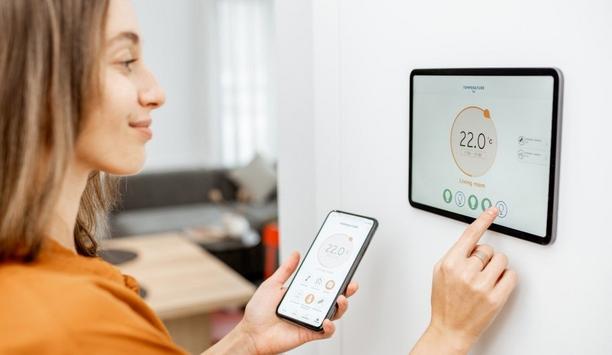
Using air conditioners and electric fans to stay cool accounts for nearly 20% of the total electricity used in buildings around the world, according to a report from the International Energy Agency. hybrid work model As a unique mix of key factors, such as the adoption of the hybrid work model and escalating heatwaves in certain regions of the United States keep people indoors for longer periods, this 20% share represents an increasingly costly line item on household budgets. Those within the market are responding by seeking out products that can help them control climates more efficiently. Smart thermostats and inverters Markets for smart thermostats and inverter HVAC controllers are clear illustrations of in-demand technology Given what the industry is experiencing, the markets for smart thermostats and inverter HVAC controllers, which are clear illustrations of in-demand technology, are experiencing growth. But as they do, are the technologies growing together or growing apart? Rapid Growth in Both Markets Discounts and incentives The smart thermostat market has expanded steadily in recent years, with that growth projected to continue through the 2020s in part due to savings of up to 8% on energy bills homeowners can recoup with the best smart thermostats. The sleek design and digital interface of modern smart thermostats, coupled with the increased control capabilities provided by mobile applications, seem to offer homeowners unprecedented control over their indoor climate. Moreover, the growing popularity of rebate programs providing discounts and incentives is making these solutions even more attractive. Real-time heating/cooling needs with Inverter/VRF Inverter/VRF HVAC systems are capable of adjusting the frequency of the compressor precisely Concurrently, the market for Inverter/VRF HVAC control systems is also expanding. It is estimated that the global Inverter/VRF market will grow from USD $17.6 billion (2020) to $31.9 billion (2025) at a CAGR of 12.7%, with the US identified as the fastest-growing Inverter/VRF market. Unlike their single-speed system counterparts which operate on an on/off or all-or-nothing dichotomy, Inverter/VRF HVAC systems are capable of adjusting the frequency of the compressor to precisely match the real-time heating/cooling needs of an environment. By regulating the fan speed and airflow, Inverter/VRF systems are extremely efficient at keeping an environment at a precisely set temperature. Enhanced HVAC system performance or not? Given the rapidly expanding markets, one might think that the easy interface of the current smartest thermostats and the operational efficiency of the best Inverter/VRF HVAC controllers could combine to create an exceptionally comfortable and cost-efficient experience for homeowners, and an easily interoperable install for HVAC pros. However, the question remains: have these devices genuinely enhanced HVAC system performance in terms of accuracy, consistency, and efficiency? More importantly, have they made living spaces more comfortable? Have these growing markets and technological advancements made life easier for industry pros? Persistent and pervasive incompatibility This communication breakdown leads to issues such as set temperature variance, inefficient operation Many are surprised to discover that the response to these important queries is frequently negative and “no”, due to a persistent and pervasive incompatibility between smart thermostats and Inverter/ VRF HVAC controllers. It is this incompatibility that ultimately negates the advanced features and intelligence of each product. This communication breakdown leads to issues such as set temperature variance, inefficient operation, and energy consumption. Confronting the Critical Interoperability Challenges Ideally, the current smart thermostats, and the benefits they bring such as user-friendly interfaces, would integrate flawlessly with high-efficiency Inverter/VRF HVAC systems, enhancing comfort and cost-efficiency while simplifying installation for HVAC professionals. Unfortunately, this ideal scenario is elusive. The core problem stems from these technologies developing and evolving separately, and in isolated environments. Inadequate two-way communication While individual support for certain protocols may exist, they fail to communicate complex instructions effectively While individual support for certain protocols may exist, they fail to communicate complex instructions effectively due to inadequate two-way communication. When a smart thermostat is improperly paired with an intelligent Inverter/VRF HVAC system, the resulting communication breakdown forces the HVAC system to revert back to single-speed operations, completely undermining its full potential, and sophisticated features. Inefficiency and discomfort Given its prevalence, what does this incompatibility mean for HVAC professionals and their clients? Consider a scenario where a user desires to adjust the indoor temperature to 68°F via a smart thermostat. Since the Inverter/VRF unit can only be adjusted by means of its own communication protocol, and the output of the smart thermostat is a dry contact closure, the 68°F would never be properly relayed to the air conditioner. In other words, the smart thermostat does not provide information on how hard the system is working or the deviation of the current temperature from the desired set point. As a result, the system cannot modulate its output to precisely match the temperature needs of an environment, and the air handling unit within the system is forced to always operate at high speeds creating inefficiency and discomfort. On-and-off mode Homeowners miss out on the benefits of their investment, and installers find themselves in the predicament Moreover, this style of operation is quite noisy, as the HVAC system drones on at full capacity every time it is reactivated. This on-and-off mode of operation consumes more energy, comparable to stop-and-start gas-guzzling city driving versus smooth highway cruising. Both homeowners and installers bear the brunt of these drawbacks, homeowners miss out on the benefits of their investment, and installers find themselves in the predicament of either explaining this intricate issue or spending valuable time troubleshooting. What Can Be Done to Address Incompatibility? While this convergence of technology and home comfort presents significant potential and profound challenges, this situation is not without a solution. The industry’s most advanced smart thermostats and efficient Inverter/VRF HVAC controllers both possess impressive capabilities, but the key to success lies in improving their ability to fluently exchange commands and information. Translator between smart thermostat and Inverter/VRF These remarkable devices contain the unit's protocols, deftly translating the commands of the smart thermostat Thankfully, there are solutions within the market from industry pioneers that act as a "translator" between the smart thermostat and the Inverter/VRF unit. These remarkable devices contain the unit's protocols, deftly translating the commands of the smart thermostat, creating a seamless conduit of communication. Enhancing interoperability Enhancing interoperability is a prevailing trend across the smart home sector, and it is imperative the HVAC industry works to align with this trend. By embracing such changes, HVAC professionals can offer unparalleled value and functionality to their clients while simultaneously reducing installation complexities. This paradigm shift offers a unique opportunity to alleviate their challenges while providing customers with extraordinary value and performance from their HVAC systems.


