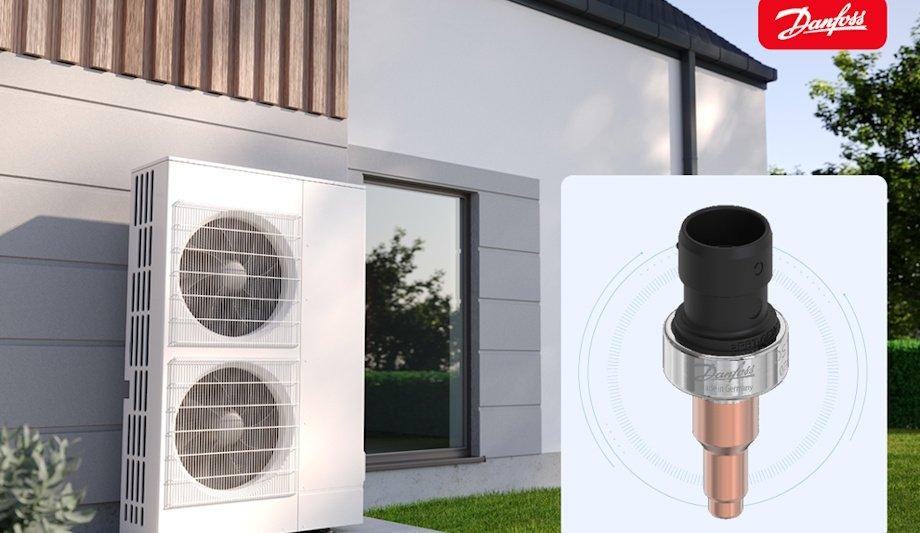
The DST P070, a recent addition to Danfoss Sensing Solutions' DST series of pressure sensors, is tailored for heat pump applications.
This sensor addresses key industry challenges with a compact design, offering reliable pressure sensing technology suitable for HVAC installations where space is limited.
Meeting Industry Demands
The shift away from fossil fuel-based HVAC systems has placed heat pumps at the forefront of energy transition efforts. The European Union's REPowerEU initiative, for instance, aims to double the install rate of heat pumps every four years, targeting 60 million installations by 2030.
Danfoss' DST P070 sensor provides a solution for HVAC system builders facing the challenge
Danfoss' DST P070 sensor provides a solution for HVAC system builders facing the challenge of integrating compact and lightweight sensors into their designs.
"The DST P070 addresses this challenge by offering reliable pressure-sensing technology in a compact design," said Iro Dragoumi, Segment Manager for HVAC&R at Danfoss Sensing Solutions.
Innovative Design Features
The DST P070 incorporates backside MEMS technology, optimizing its value, size, and weight for HVAC applications. Its bi-metal pressure connection is ideal for use in tight spaces such as heat pumps, chillers, residential air conditioning units, and refrigeration systems.
"The DST P070 offers the shortest solder tube length on the market, a small body sensor, and a single-brazing point, facilitating easier installation in confined spaces," explained Katharina Löhden, Product Manager for Pressure Sensors at Danfoss Sensing Solutions. Additionally, the sensor’s lightweight design reduces the need for vibration support, simplifying setup.
Streamlining Installation
The sensor's bi-metal solder tube not only fits narrow spaces but also simplifies the installation process
The sensor's bi-metal solder tube not only fits narrow spaces but also simplifies the installation process. Its copper and stainless steel construction eliminates the need for cooling protection during soldering, reducing overall installation time.
This construction features superior welds and precision brazing, lowering heat transfer more effectively than copper or brass, thus prolonging the sensor's lifespan.
Compatibility with Low-GWP Refrigerants
Danfoss has tested the DST P070 with an extensive range of refrigerants, confirming its compatibility with A1, A2L, and A3 refrigerants, including R290 and the aggressive R1234ze.
This testing ensures the sensor can handle helium leakage, overpressure, thermal stress, vibration, and other physical demands, as validated by external laboratories. The sensor is ISO 14903 design tested, ATEX Zone 2, and HazLoc compliant.
Ensuring Shorter Lead Times
Danfoss has expanded production, establishing a new high-volume, automated line in Minden, Germany
To respond to growing market demands, Danfoss has expanded production, establishing a new high-volume, automated line in Minden, Germany. This facility sources 70% of its materials locally within the EU and ensures full parts traceability.
The site is compliant with ISO 14001, ISO 9001, and IATF 16949 standards and aligns with Danfoss' sustainability commitments, with goals to achieve carbon neutrality by 2030.
Sustainability in Focus
The DST P070's production process emphasizes sustainability. Crafted from over 50% recycled stainless steel, the sensor boasts a reduced carbon footprint due to its compact design. Danfoss has also introduced an innovative pulp tray packaging, effectively cutting CO2 emissions and transport volume by 50% while maintaining protective strength.
"With the DST P070, OEMs benefit from a sensor designed for top-quality HVAC applications and one that supports a sustainable manufacturing process," concluded Iro.
As the latest in the DST series of durable, compact pressure sensors from Danfoss Sensing Solutions, the DST P070 offers a range of features ideally suited for heat pump installations.
"Heat pumps play a central role in our transition away from fossil fuel-driven HVAC systems. For example, the REPowerEU targets require that the amount of newly installed heat pumps double every four years, meaning they will need 60 million more heat pumps installed by 2030."
"Yet, HVAC system builders often struggle to find sensors compact and lightweight enough to satisfy smaller system requirements. The DST P070 addresses this challenge by offering reliable pressure-sensing technology in a compact design," Iro Dragoumi, Segment manager for HVAC&R at Danfoss Sensing Solutions.
Bi-metal pressure connection
The pressure sensor features backside MEMS technology which enabled its value, size and weight to be optimal for HVAC applications.
The compact bi-metal pressure connection offers the best fit in applications with small and narrow spaces, such as heat pumps, chillers, residential and transport air conditioning units and food service refrigeration.
sensor’s lightweight design
“The DST P070 offers the shortest solder tube length on the market, a small body sensor and a single-brazing point, all designed to make it easier for installers to work within the space constraints in heat pump installations."
"And because of the sensor’s lightweight design, there’s practically no need for vibration support, which makes for a simple, effortless setup,” Katharina Löhden, Product manager for pressure sensors at Danfoss Sensing Solutions.
Simplifying the installation process
In addition to offering the best fit in narrow installation spaces, the bi-metal solder tube also provides several installation benefits. “When you have a pressure sensor with copper solder tubes, you need cooling protection for the sensor during the soldering process. In the DST P070, the pressure connection is made of copper and stainless steel which, in addition to being durable, can eliminate the need for cooling protection during installation. This shortens installation time and makes the entire process easier for the installer.”
The bi-metal solder tube also features superior welds to the housing and precision brazing to the pipe. It also has a lower heat transfer than copper or brass, which protects system components and extends the sensor’s lifetime.
Fully compatible with low-GWP refrigerants
In keeping with the company’s commitment to supporting the HVAC industry through the refrigerant transition, the Danfoss Sensing Solutions team tested the DST P070 across a wide range of refrigerants and oils to ensure its compatibility with A1, A2L, and A3 refrigerants.
“We have validated that the DST P070 works with R290, the main heat pump refrigerant, and it’s compatible with the aggressive R1234ze refrigerant as well,” says Iro.
The sensor also features the company’s patented sealing technology, ensuring hermetical tightness, and has undergone a series of validation and tightness control tests to confirm it can withstand helium leakage, overpressure, thermal stress and aging, vibration and a combination of temperature and vibration exposure. Test results have been validated by an external laboratory and the DST P070 is ISO 14903 design tested and ATEX Zone 2 & HazLoc compliant.
Guaranteeing shorter lead times and supply chain integrity
To meet the increasing demand for heat pumps, OEMs need a reliable supplier who can deliver system components on time. “Our customers tell us that they’re looking for global suppliers that can provide high-quality products and round-the-clock support. To accommodate this, we’ve expanded our production footprint and hence created a new, high-volume, fully automated production line in Minden, Germany. This line will enable us to offer our customers shorter lead times, so they receive orders swiftly and efficiently.”
The production facility sources 70% of its materials from within the EU and offers full traceability on parts and process data. The site is also ISO 14001, ISO 9001, and IATF 16949 compliant and fully aligned with the company’s ESG commitment.
“As is the case with many of our customers, Danfoss is committed to reducing our carbon footprint. In line with these goals, our facility in Minden is on track to be carbon neutral by 2030.”
Putting sustainability first: from production to packaging
Sustainability has also played a significant role in the entire DST P070 production process, from manufacturing to packaging. “The sensor contains more than 50% recycled stainless steel and it has a lower total carbon footprint, thanks to its compact design and use of fewer materials,” Katharina explains.
“We’ve developed a unique pulp tray packaging, which reduces our CO2 emissions by 50% and transport volume. Yet the design offers the same strength and durability to protect sensors during transport.”
Combination of a simplified installation process
The combination of a simplified installation process, proven quality, low-GWP refrigerant compatibility and ESG-compliance add up to a pressure sensor that equips OEMs to meet market demand, industry regulations and internal sustainability requirements.
“In the DST P070, OEMs get a pressure sensor designed to work with heat pumps, chillers and other HVAC applications – one that meets the highest quality standards and that is readily available. And with our end-to-end commitment to sustainable manufacturing, we can offer a component that helps our customers work towards a carbon-neutral future,” concludes Iro.